
Samsung
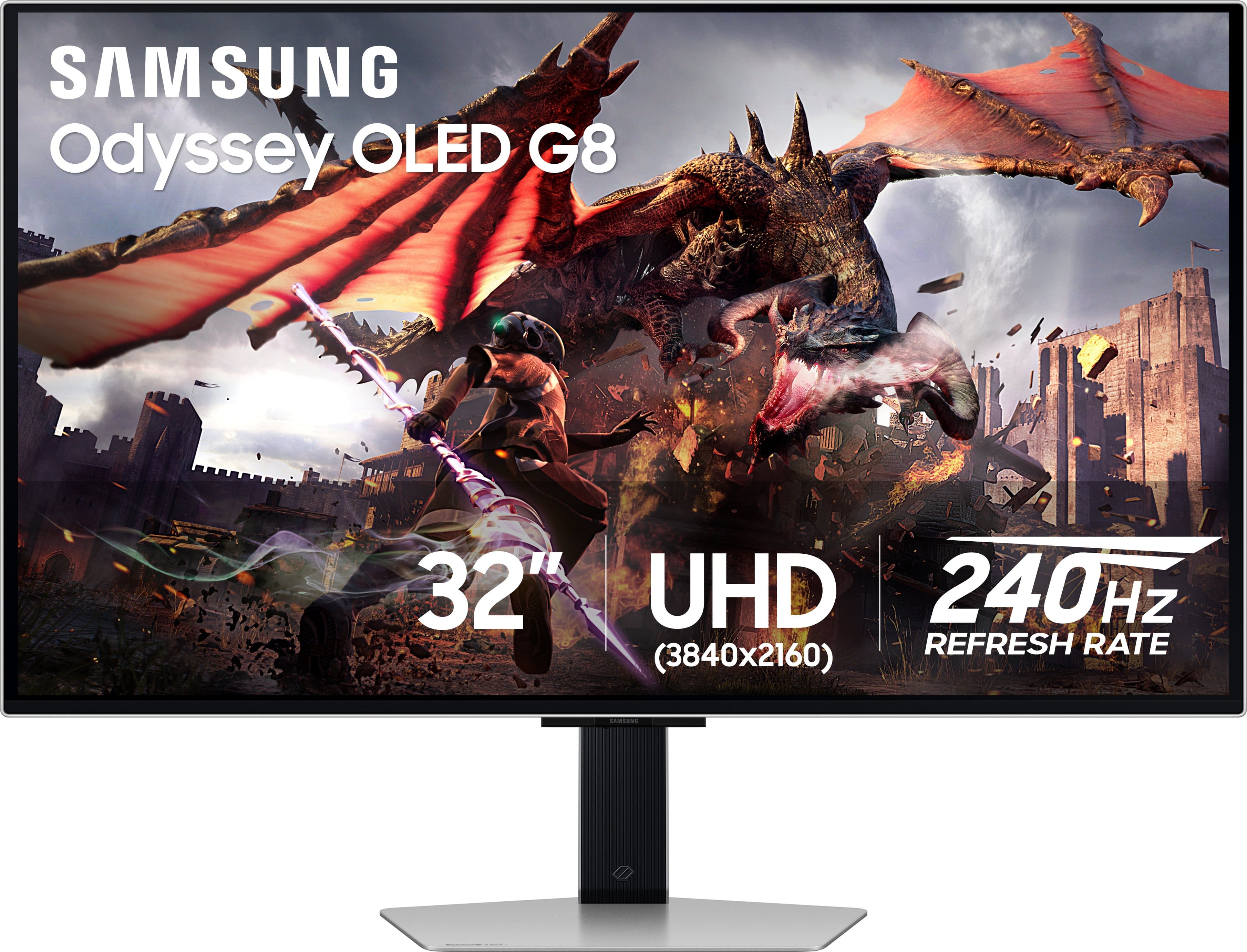
Odyssey OLED G8 32" Gaming Monitor
Affiliate Disclosure: We may earn a commission when you buy through links on our site. This does not influence our editorial recommendations. Learn more about how we make money
Clara’s Verdict
ExcellentIncredible 4K gaming monitor with stunning colors and smooth performance, but the premium price tag makes it tough to justify unless you really want the best.
Best for: serious gamers with powerful PCs, content creators who game, anyone wanting a gorgeous all-in-one entertainment display
Skip if: budget-conscious buyers, those who need perfect color accuracy, casual gamers
Ethan’s Verdict
Very GoodFirst 4K 240Hz OLED monitor delivers on speed but stumbles on brightness and color accuracy for the price.
Best for: competitive gamers who prioritize 240Hz over color work, streamers wanting built-in smart features, users with high-end GPUs to justify the specs
Skip if: color-critical professionals, budget-conscious gamers, anyone needing peak brightness for HDR
Clara’s Pros & Cons
- +Absolutely stunning picture quality with vibrant colors
- +240Hz at 4K makes gaming incredibly smooth
- +Sleek, premium design that looks beautiful
- +Built-in speakers and smart features work great
- −Very expensive, even on sale
- −Color accuracy lags behind competing OLED monitors
- −No headphone jack is inconvenient
- −Requires a really powerful GPU to maximize
Ethan’s Pros & Cons
- +First 4K 240Hz OLED monitor with stable performance.
- +Sub-1ms input lag and 0.03ms response time are genuinely excellent.
- +QD-OLED contrast and color vibrancy punch above the competition.
- +Built-in smart features and speakers add real value for streamers.
- −191 nits typical brightness is disappointingly low for the price.
- −Color accuracy worse than competing 4K OLEDs at similar cost.
- −Glossy panel causes reflections in anything but dark rooms.
- −Most expensive 32-inch 4K OLED with the weakest color performance.
Score Breakdown
Picture Quality9.018% wt
HDR & Color Accuracy7.512% wt
Motion & Gaming9.518% wt
Design & Build8.522% wt
Smart Features8.012% wt
Connectivity8.58% wt
Value6.010% wt
Score Breakdown
Picture Quality8.025% wt
HDR & Color Accuracy7.015% wt
Motion & Gaming9.020% wt
Design & Build8.010% wt
Smart Features7.510% wt
Connectivity8.510% wt
Value5.510% wt
Clara’s Full Review
A Beautiful Gaming Monitor That Costs a Lot
Okay, so here's the thing about the Samsung Odyssey OLED G8: it's genuinely gorgeous and gaming on it is a dream. Reviewers consistently praised the vibrant colors and the way games look on that 4K OLED panel. The 240Hz refresh rate at 4K resolution is still pretty rare, and when you combine that with the 0.03ms response time, scrolling through menus and playing fast-paced games feels incredibly smooth. That's the whole point of a gaming monitor, and this one absolutely delivers.
What's really nice is that this isn't just a gaming monitor. It's got built-in speakers that actually sound good, a Gaming Hub that lets you stream games, and Smart TV apps for entertainment. So if you want one beautiful display that handles everything, it works.
Here's where I get a little honest though. This monitor is expensive. Really expensive. At $1,299 MSRP (currently $960 on Amazon), you're spending serious money. And reviewers found that despite the premium price, the color accuracy is actually slightly worse than competing OLED monitors that cost less. If you're doing any color-critical work, that's worth knowing.
The brightness levels are also a touch lower than competitors, which might matter if you're in a very bright room or doing professional color work. For gaming though, it's totally fine. The contrast is incredible because it's OLED, so blacks are actually black.
One small thing: there's no headphone jack, which feels like an oversight on a $1,300 monitor. You'll need to use wireless headphones or USB.
The real question is whether you need 4K at 240Hz badly enough to justify the price. If you've got a powerful GPU and want the absolute best gaming experience, this delivers. If you're a casual gamer or on a budget, there are other excellent OLED monitors that cost less and actually have better color accuracy. But if you want one gorgeous monitor that handles gaming, movies, and entertainment beautifully, and you've got the budget for it, this is genuinely excellent.
Ethan’s Full Review
The Specs Are Impressive. The Execution Isn't.
Samsung's Odyssey OLED G8 is the monitor equivalent of a car with a 600-horsepower engine and cheap brakes. On paper, 4K at 240Hz with QD-OLED technology sounds like the ultimate gaming monitor. In practice, you're buying a speed demon that skimps on the fundamentals.
Let's start with what Samsung nailed. The motion handling is genuinely exceptional. Sub-1ms input lag, 0.03ms response time, and stable 240Hz performance across demanding titles like Fortnite and Horizon: Forbidden West make this the fastest 4K gaming monitor available. If you're a competitive player with a RTX 4090 or equivalent, this refresh rate at 4K resolution is a meaningful advantage. The connectivity is correct too: HDMI 2.1 and DisplayPort 2.1 deliver the bandwidth without bottlenecks.
But here's where Samsung lost the plot. At 191 nits typical brightness, this monitor is dim. Genuinely dim. For a $960 display, that's not a quirk, it's a failure. Sustained HDR brightness of 369 nits is fine for dark-room gaming but embarrassing for a monitor positioned as an entertainment hub. You're watching movies at reduced peak brightness compared to competitors charging less.
The color accuracy problem is worse. Delta E of 2.9 is acceptable in isolation, but PCMag's testing shows this is the worst color accuracy among 32-inch 4K OLEDs released this year, and it's the most expensive. That's not a trade-off, that's a business decision that penalizes your wallet. The Alienware AW3225QF and Asus ROG Swift OLED both offer better color accuracy at lower prices.
The glossy screen is another questionable choice. QD-OLED's infinite blacks don't need reflection-free glass to shine, and the glossy finish introduces distracting reflections in any room with ambient light. This is a design choice that benefits Samsung's manufacturing costs, not your viewing experience.
What Samsung does offer beyond raw performance is real. The Gaming Hub and Smart TV apps work, the NQ8 AI processor handles upscaling without embarrassing artifacts, and the built-in speakers actually sound good. For someone who wants a monitor that doubles as an entertainment device, these features have value. But they're not worth $960 when the core display metrics are compromised.
The math is simple: you're paying flagship pricing for a monitor that chose speed over everything else. If 4K 240Hz gaming is your only requirement and you have the GPU to back it up, the performance is uncompromising. For anyone else, the Alienware or Asus monitors deliver better overall execution at lower cost.
Specifications
| hdr | DisplayHDR True Black 400 |
| display | 32" QD-OLED |
| resolution | 3840x2160 |
| connectivity | HDMI 2.1, DP 2.1 |
| refresh rate | 240Hz |
| response time | 0.03ms |
Overall Rating
Related Reviews
ASUS ROG Swift PG32UQX vs Acer Nitro XV272U vs LG UltraGear 48GQ900-B
ASUS ROG Swift PG32UQX, Acer Nitro XV272U, or LG UltraGear 48GQ900-B? We compare HDR, gaming performance, and value to find the best monitor for you.
Dell Alienware AW3423DW vs ASUS ROG Swift OLED PG27AQDM (2024)
Dell's ultrawide QD-OLED battles ASUS's 240Hz OLED gaming monitor. We analyze performance, value, and real-world testing to declare a definitive winner.
Best Monitors 2026: Top Picks Reviewed
Our experts analyzed 5 top monitors based on professional reviews from 25 expert sources. See our top picks for 2026.
Review History
Initial review from real source data
Initial review from real source data
Editorial Independence
Our reviews are based on research from trusted expert sources. We may earn commissions from affiliate links, but this never influences our ratings or recommendations. How we score · Editorial policy · Report an error
Related Monitors


Lowest Price Vendor Auto-Selected
Lowest Price Vendor Auto-Selected