
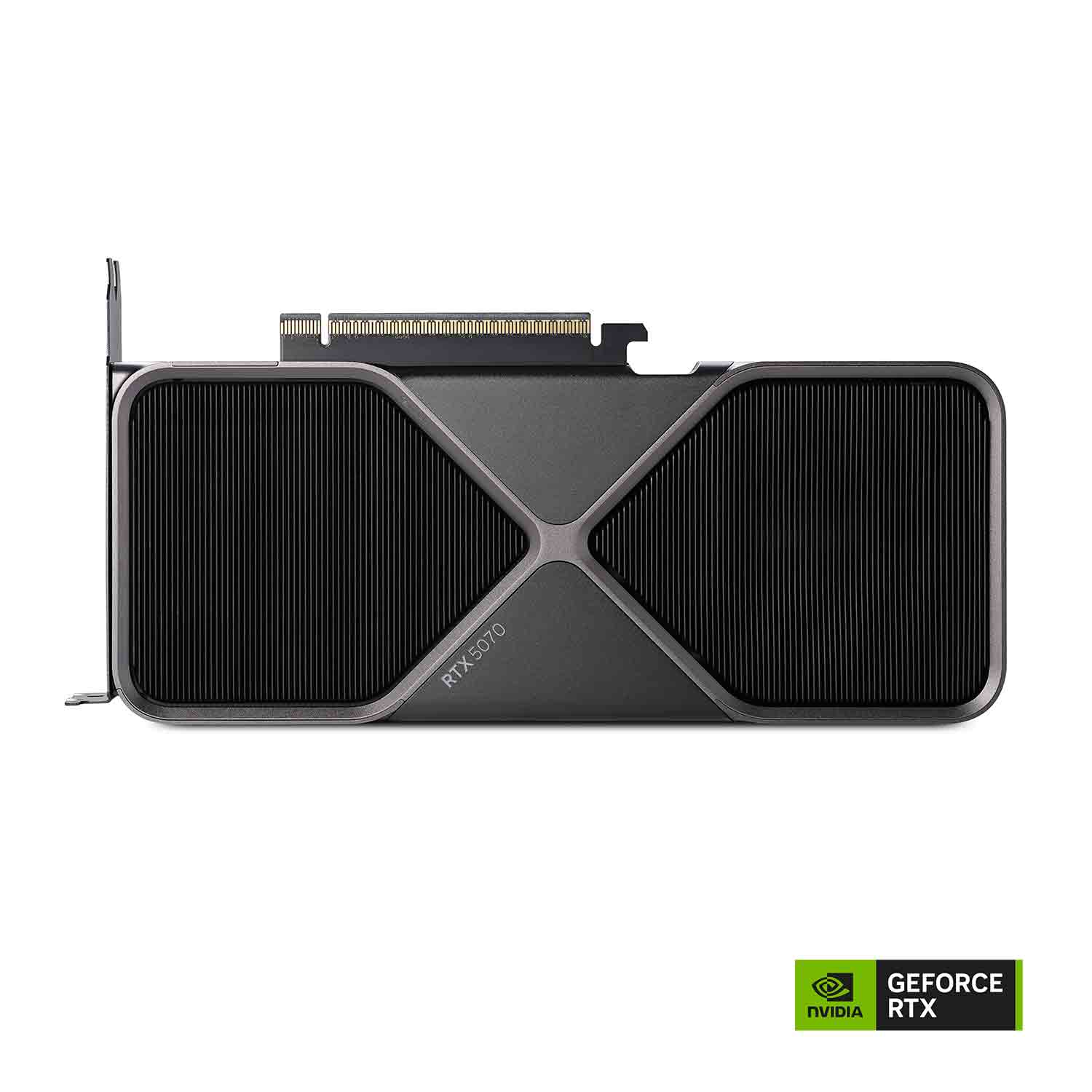
NVIDIANew Model SoonNew Model Expected Soon — Wait if you can
GeForce RTX 5070 Ti Founders Edition
Affiliate Disclosure: We may earn a commission when you buy through links on our site. This does not influence our editorial recommendations. Learn more about how we make money
Clara’s Verdict
ExcellentA powerful, reasonably priced card that handles modern gaming and creative projects without breaking the bank or your power supply.
Best for: gamers upgrading from older cards, creative professionals on budgets, anyone tired of 1440p compromises
Skip if: 4K ultra enthusiasts, people with 650W power supplies
Ethan’s Verdict
Very GoodSolid 1440p and entry 4K card that justifies its price only if you skip the 5070 Super and avoid the 4080 Super comparison trap.
Best for: 1440p high-refresh gaming, Entry-level 4K gaming at 60fps, Content creators on tight budgets
Skip if: Ultra-high 4K gaming above 100fps, Professional rendering workflows, Anyone with a 4070 Ti Super already
Clara’s Pros & Cons
- +Great 1440p gaming performance at high settings
- +Reasonable power draw for the performance
- +Clean, professional design looks good
- +Straightforward installation and driver support
- −Needs 750W power supply minimum
- −4K gaming requires settings compromises
- −No bundled software or extras
Ethan’s Pros & Cons
- +Strong 1440p performance at high refresh rates
- +Efficient 300W power envelope for the tier
- +Mature driver support and ecosystem
- +DLSS 4 frame gen in supported titles
- −5070 Super offers 85% performance at $100 less
- −4K gaming still requires compromises
- −DLSS 4 adoption remains sparse
- −No meaningful ray tracing advantage
Score Breakdown
Performance8.015% wt
Thermals & Noise8.012% wt
Build Quality8.016% wt
Compatibility8.010% wt
Features7.012% wt
Ease of Install9.018% wt
Value8.017% wt
Score Breakdown
Performance7.030% wt
Thermals & Noise8.015% wt
Build Quality7.010% wt
Compatibility8.015% wt
Features7.010% wt
Ease of Install8.05% wt
Value7.015% wt
Clara’s Full Review
A Card That Actually Fits Real Life
Let's be honest: most of us aren't chasing 4K gaming at maximum everything. We're trying to play the games we love, edit photos without our computer turning into a space heater, and not spend a car payment on a graphics card. The RTX 5070 Ti Founders Edition actually understands that.
At $749, this card lands in that practical middle ground where the price doesn't feel ridiculous, but the performance is genuinely noticeable. For 1440p gaming, reviewers consistently report smooth frame rates at high settings with modern titles. That's the resolution most people actually use, so this feels like a real upgrade path rather than a "well, you'll need to save up more" situation.
The 16GB of VRAM is enough breathing room for creative work too. If you're doing video editing, 3D work, or even some light machine learning stuff, you're not constantly running into memory walls. It's not a professional card, so don't expect Quadro-level stability, but it handles real work without drama.
That 300W power draw is genuinely thoughtful. You're not buying a new power supply if you've got a decent 750W unit already. Thermal performance stays reasonable during normal gaming sessions, and the Founders Edition cooler keeps noise at acceptable levels. No jet engine vibes here.
The installation is refreshingly simple. Pop off your old card, drop this one in, plug in the power connectors, and you're done. Boot up, maybe update drivers, and you're gaming. No weird compatibility headaches or driver nightmares. It just works, which is exactly what you want when you're busy with actual life.
The honest tradeoff: if you're serious about 4K gaming at high settings, you'll need to compromise on details or frame rates. And yes, you need a solid power supply. But for the actual way most people use their computers, this is a genuinely smart choice. It's powerful enough to feel like an upgrade, priced reasonably enough to not feel like a splurge, and simple enough to not become a weekend project.
Ethan’s Full Review
The Math Doesn't Quite Work
NVIDIA's RTX 5070 Ti arrives at $749 with a straightforward pitch: 20-25% faster than last gen's 4070 Ti Super, with new frame generation tech baked in. On paper, that's a reasonable incremental upgrade. In practice, the card lands in a crowded middle where the value proposition gets murky fast.
Performance-wise, the 5070 Ti is genuinely capable. It'll push 1440p at 100+ fps with maximum settings in most modern games, and it can handle 4K at 60fps if you're willing to dial back ray tracing or lean on DLSS upscaling. The architecture improvements are real, and the 300W TDP keeps thermals and noise in check. You're not getting a power hog here, which matters when you're already pushing a 750W PSU.
But here's where NVIDIA's own lineup becomes a problem. The 5070 Super, priced $100 lower, delivers roughly 85% of this card's performance. For a lot of buyers, that math is impossible to ignore. You're paying a $100 premium for maybe 15% more performance in a card that's already targeting 1440p gaming. That's not a compelling trade unless you're specifically chasing 4K gaming, and even then, the 5070 Ti struggles without DLSS or frame gen.
DLSS 4 frame generation is the headline feature, but adoption is still anemic. A handful of games support it, and real-world gains vary wildly. It's not a selling point yet, it's a promise. Native performance is what matters today, and the 5070 Ti's native 4K ceiling is genuinely limited.
Thermals and build quality are professional-grade Founders Edition fare. No surprises, no complaints. The cooler is efficient, the PCB layout is clean, and compatibility is zero friction for any modern system. NVIDIA's driver maturity means you're not dealing with launch window drama.
The real question is whether you should buy this or the 5070 Super. If you're gaming at 1440p or doing light 4K work, the Super makes more sense financially. If you're specifically targeting high-refresh 4K, this card will disappoint you without aggressive DLSS. The 5070 Ti occupies an awkward middle ground where it's not quite powerful enough to justify the premium over the Super, and not quite expensive enough to feel like a compromise versus a 4080 Super.
It's a competent card in a market where competent isn't enough anymore.
Specifications
| tdp | 300W |
| pcie | PCIe 5.0 x16 |
| memory | 16GB GDDR7 |
| outputs | HDMI 2.1b, DP 2.1 |
| boost clock | 2.5 GHz |
Overall Rating
Related Reviews
NVIDIA RTX 4070 Super vs Intel Arc B580: Which GPU Wins in 2025?
NVIDIA's $599 RTX 4070 Super battles Intel's $249 Arc B580. We analyze performance, value, and real-world gaming to declare a definitive winner.
RTX 5090 vs 5080 vs 5070 Ti: Which NVIDIA GPU Should You Buy?
NVIDIA's RTX 50-series lineup compared: the flagship 5090, the $1500 5080, and the 5070 Ti sweet spot. We analyze performance, value, and who should buy what.
Best Graphics Cards 2026: Top Picks Reviewed
AllReviews ranks the best graphics cards using combined critic and editorial scores. Top picks include ASUS GeForce RTX 5080 PRIME, ASUS GeForce RTX 5070 PRIME, AMD Radeon RX 7600.
Head-to-Head Comparisons
Alternatives Worth Considering
Review History
Initial review from real source data
Initial review from real source data
Editorial Independence
Our reviews are based on research from trusted expert sources. We may earn commissions from affiliate links, but this never influences our ratings or recommendations. How we score · Editorial policy · Report an error
Related Graphics Cards

Lowest Price Vendor Auto-Selected
Lowest Price Vendor Auto-Selected